Run your DAW with your voice.
Jacked Up Digital Engineer.
Never touch the mouse again.
JUDE — Jacked Up Digital Engineer — is an AI recording engineer on the other side of the glass. Talk the way you would to a human: “arm the drums”, “let's do one”, “play that back”. Jude drives your transport, tracks and faders like an engineer at the desk, so your hands stay on the instrument.
macOS · Logic Pro · GarageBand · Reaper · Cubase / Nuendo · no credit card for the trial
Plain speech in.
Real control surface out.
No command syntax, no cheat sheet. Jude hears intent, calls the tool, and confirms out loud — then verifies against what the DAW actually reported back. Talk open-mic, push-to-talk, or hands-free with the “Hey Jude” wake word.
17
Engineers to work with
7
Languages spoken
0
Mouse clicks between takes
14
Days free, no credit card
An engineer at the controls.
Jude connects to your DAW the same way professional control surfaces do — Logic Pro, GarageBand, Reaper and Cubase/Nuendo, all supported out of the box. Nothing to install in your DAW, no scripting, no plug-in.
You talk
Jude listens and works the DAW for you, so you can stay focused on performing.
The engineer answers
Your engineer answers in their own voice, with the conversational ease of Alexa+. On headphones, interrupt any time — Jude stops mid-sentence and listens.
Jude works the console
Jude presses the buttons and rides the faders for you — the same way a hardware control surface would.
Your DAW moves
Transport rolls, tracks arm, faders ride — in Logic Pro, GarageBand, Reaper and Cubase/Nuendo.
And back again. Jude watches everything your DAW reports — track names, what's armed, where the playhead is — and never assumes a command worked: it checks. Grab the mouse mid-session and Jude stays right with you.
Transport, spoken
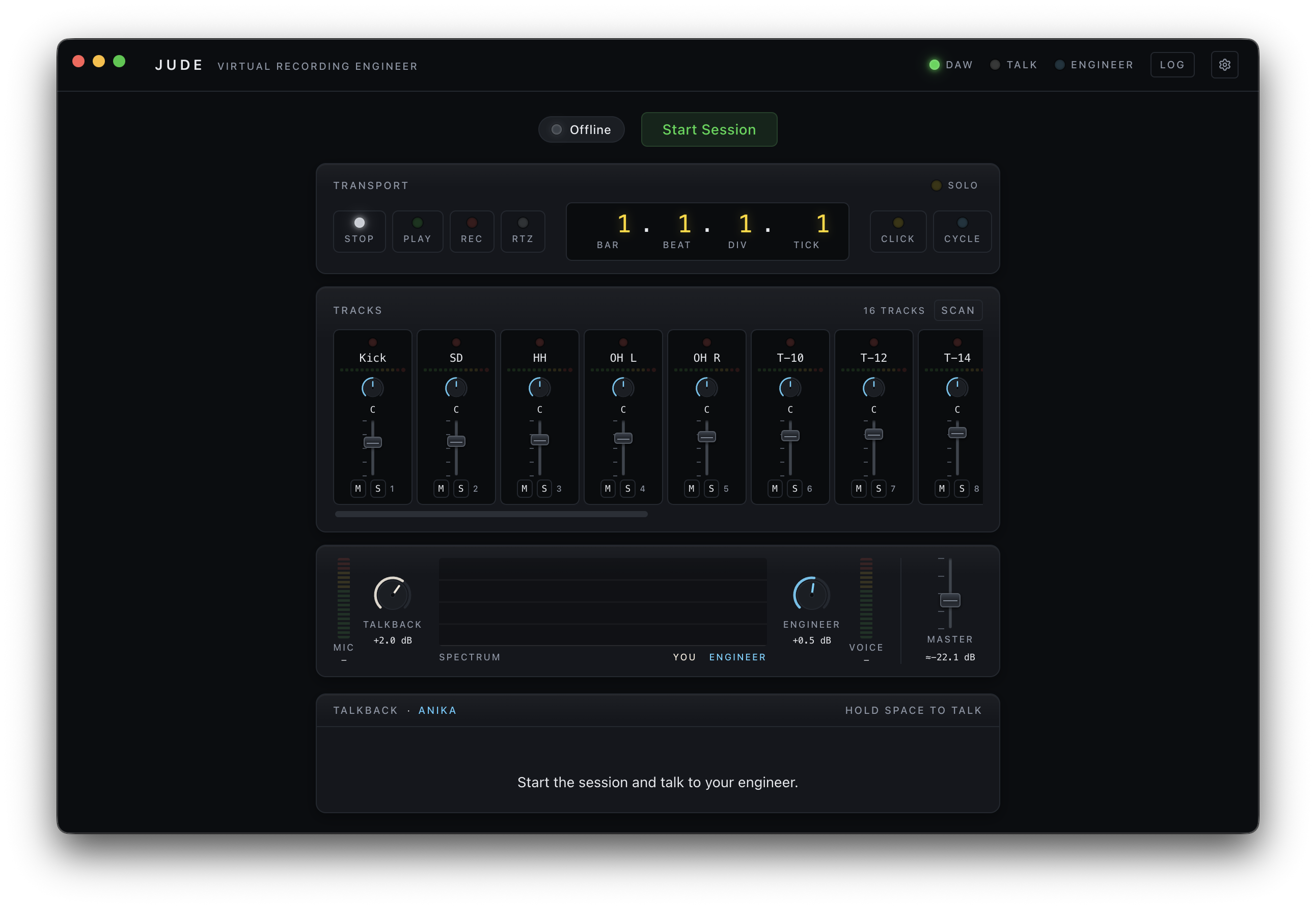
Record, stop, play, return to start, click and cycle — all by voice, each confirmed as done. The count-in starts while your sticks are still in the air.
A take ledger that keeps up
“Trash that”, “let's keep that one”, “play the last one back”. Jude tracks every pass of the session, so you can stay in the performance and sort it out by talking.
Faders in real dB
“Give me more on the overheads” moves the right strips by a musical amount, and the resulting dB is read back to you. Master fader for the room, strips for the mix.
Arm, mute, solo — in groups
“Arm the drums” hits five strips. “Mute everything except the vocal” does exactly that. Whole sections, single tracks, or everything-but — Jude keeps up.
A real meter bridge
Per-strip meters that move like the real thing. The meter bridge is instrumentation, not decoration.
Ask it anything about the session
“What channels are configured?”, “what's armed?”, “where are we?”. Anything the interface shows, Jude can say — the engineer is your eyes on the console.
Built to sit next to your favorite plug-ins
Segment-display timecode, LED transport, knobs and faders with dB readouts, live spectrum on the talkback channel. Everything on screen has a spoken twin — and everything spoken has a control you can reach with a mouse when you'd rather.
Works with the DAW you already record in.
Jude is built for each DAW individually, and it's honest about every one of them: if your DAW can't do something, the engineer tells you straight instead of pretending.
FULLY SUPPORTED
Logic Pro
Logic finds Jude on its own the moment it opens, stays in step as your project changes, and stacks overlapping records into Take Folders.
NEW · EXPERIMENTAL
GarageBand
Nothing to configure inside GarageBand: grant one macOS permission, open your project, and transport, takes, mute, solo, arm, faders and per-track input monitoring all answer to your voice — with GarageBand's window staying right where you left it.
FULLY SUPPORTED
Reaper
Track names, transport, mute, solo, click and cycle — all under voice control, with two ways to connect (OSC or Mackie Control) and nothing extra to install.
FULLY SUPPORTED
Cubase & Nuendo
Transport, track names, faders and meters, all under voice control in both Cubase and Nuendo — and the multi-surface setup puts every track in the project live at once.
On the roadmap
Pro Tools, Ableton, Studio One
More DAWs are on the way. Tell us which one you record in and it moves up the list.
You don't pick a voice. You pick who's running your session.
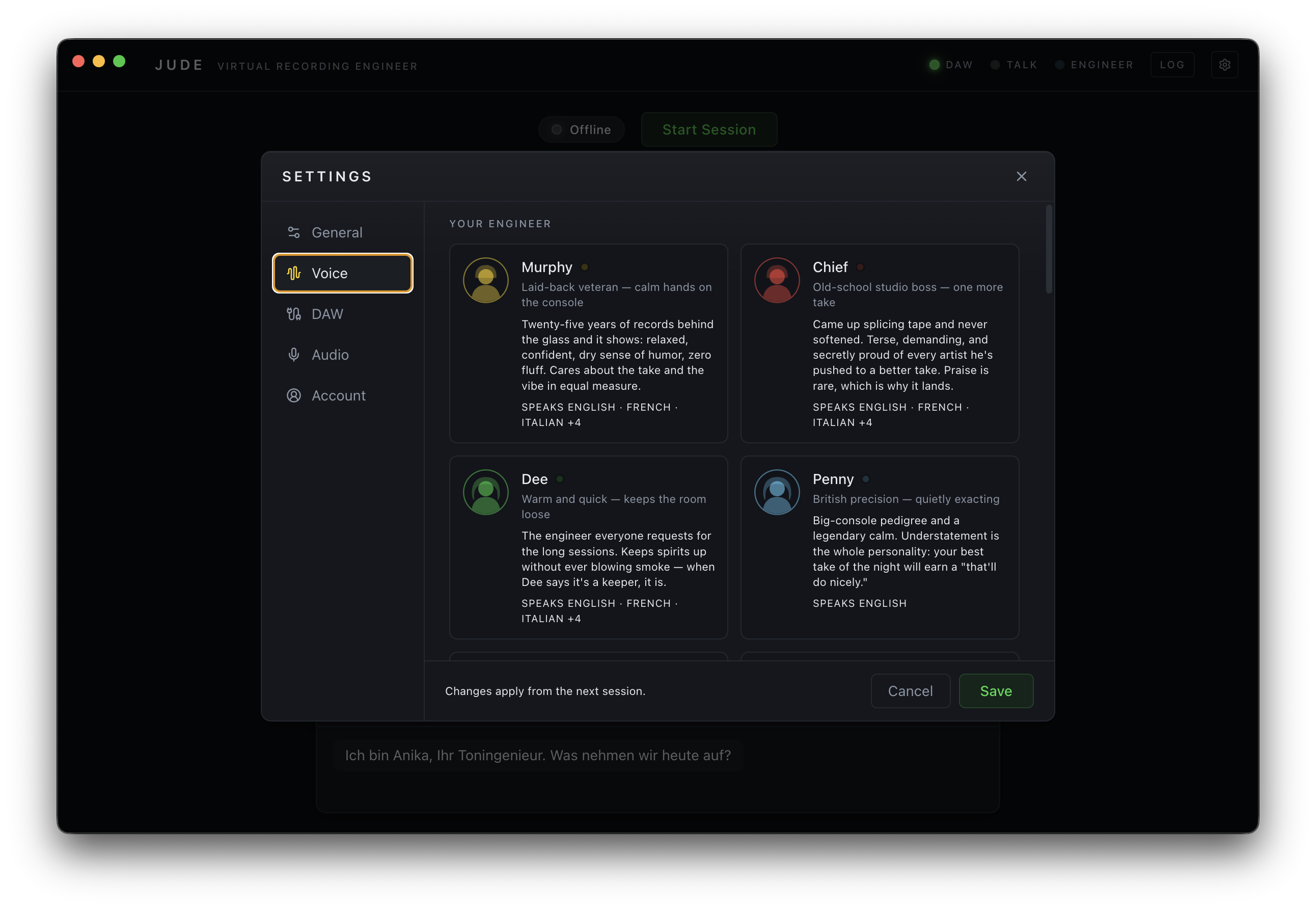
Seventeen engineers, each with a real character, a home language and their own way of calling a take. Murphy is laid back. Chief wants one more. Penny will say “that'll do nicely” and mean it as high praise.
{{ p.tagline }}
{{ p.langs }}
{{ p.tagline }}
{{ p.langs }}
Built so visual impairment doesn't slow your creativity
Accessibility is not a mode in Jude — it's how the whole product works. Anything on screen can be asked for out loud, and anything you could click, you can say. The engineer answers your questions completely and honestly, including when a DAW can't do something. If a feature can't be used by voice, we don't ship it.
If you record without sight, we want to hear from you during the beta — that feedback shapes the product more than any other.
Less than a couple of coffees a month.
Creator is $9 a month — about a pair of drumsticks — or $6.58 a month on the annual plan. The meter only runs while your engineer is working, it pauses when you step away, and hours beyond your plan are metered honestly.
Trial
Free
14 days, no credit card. 45 minutes of studio time to record with your engineer.
Creator
Regular price $9 a month, first month $$9 $ first month$9/mo
Limited-time launch offer — use code at checkout by . Monthly plans, new subscribers, not applied automatically.
6 studio hours a month, then $2.00/hr. $79 a year. For the hobbyist tracking on weekends.
Pro
Regular price $19 a month, first month $$19 $ first month$19/mo
Limited-time launch offer — use code at checkout by . Monthly plans, new subscribers, not applied automatically.
15 studio hours a month, then $1.50/hr. $169 a year. For recording most days of the week.
Studio
Regular price $49 a month, first month $$49 $ first month$49/mo
Limited-time launch offer — use code at checkout by . Monthly plans, new subscribers, not applied automatically.
50 studio hours a month, then $1.25/hr. $439 a year. For rooms that track daily.
Get behind the glass.
A 14-day free trial with 45 minutes of studio time and the whole feature set — no credit card. Sign up, pick your engineer, and tell them what you're recording today.
macOS 13 or later, Apple silicon & Intel — Windows coming soon.